
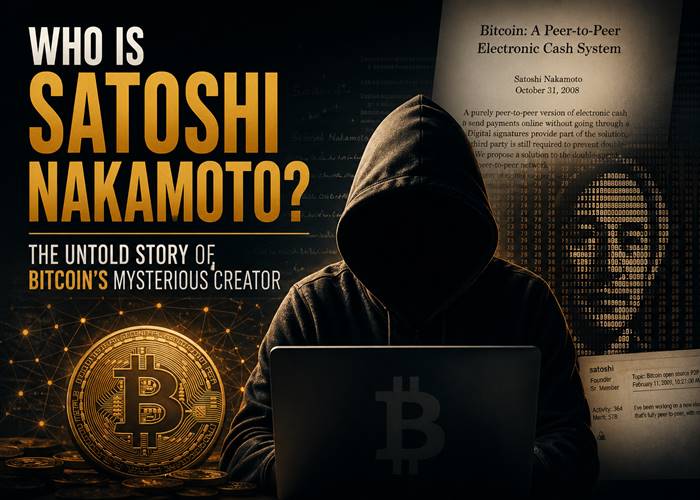
The Mystery That Defines Cryptocurrency.
Imagine inventing something that grows into a $1.5 trillion industry—then walking away without taking credit. That is exactly what Satoshi Nakamoto did.
If you have spent any time reading about Bitcoin, you have likely come across the name Satoshi Nakamoto. But who is Satoshi Nakamoto, really? The short answer is: no one knows. Despite launching the most revolutionary financial technology of the modern era, Nakamoto remains a complete mystery. This pseudonymous figure—or possibly group of people—is credited with inventing Bitcoin, publishing its original whitepaper in 2008 and launching the Bitcoin network in early 2009.
This comprehensive guide explores everything we know about Satoshi Nakamoto: the creation of Bitcoin, the mysterious disappearance, the untouched fortune, and every major theory about his true identity. Whether you are a crypto beginner or a seasoned investor, understanding the story of Bitcoin’s creator is essential to understanding Bitcoin itself.
The Bitcoin Whitepaper That Started It All
Everything began with a nine-page document titled “Bitcoin: A Peer-to-Peer Electronic Cash System.” Released to a small cryptography mailing list on October 31, 2008, the whitepaper outlined a bold new vision: a decentralized digital currency that did not require banks, governments, or middlemen to function.
At the heart of this idea was the blockchain, a distributed ledger that solved the “double-spending problem” by making every transaction publicly verifiable and permanently recorded. It was not just a novel concept—it was a direct response to the failings of traditional finance in the wake of the 2008 economic crisis.
On October 31, 2008, Satoshi Nakamoto published the Bitcoin whitepaper on the metzdowd.com website’s cryptography mailing list. The paper described an electronic currency algorithm he called “Bitcoin”.
The Birth of the Bitcoin Network
On January 3, 2009, Nakamoto mined the first block of Bitcoin—known as the genesis block—and the network officially went live. The message embedded in that first block was a headline from The Times newspaper: “The Times 03/Jan/2009 Chancellor on brink of second bailout for banks”. This made it clear this was about more than just code. It was a political statement.
Shortly after, Nakamoto released the first Bitcoin software and officially launched the Bitcoin financial system.
Satoshi‘s Two-Year Window of Public Activity
From early 2009 through late 2010, Satoshi Nakamoto was not only active but incredibly hands-on. He released the first version of the Bitcoin software, communicated with early adopters via emails and online forums, reviewed code contributions, and even managed the project’s domain names and repositories.
He was polite, technical, and deeply focused on Bitcoin’s mission—but never revealed anything personal. No face. No voice. No name beyond “Satoshi Nakamoto.” He responded to questions, explained design decisions, and welcomed feedback, but kept the focus strictly on the technology.
His last public appearance on forums occurred in December 2010 on the Bitcointalk forum, where he discussed technical aspects related to security and potential attack vectors.
The Mysterious Disappearance of 2011
Then, just as quietly as he arrived, Nakamoto stepped away. By the end of 2010, his public activity ceased.
His final known message came on April 23, 2011. The email, addressed to software developer Mike Hearn, marked the definitive closure of his public presence on the project that would give rise to the entire cryptocurrency industry.
The email that sealed Satoshi‘s disappearance is brief, almost laconic, but profoundly significant. He wrote:
“I’ve moved on to other things. It’s in good hands with Gavin and everyone.”
The reference was to Gavin Andresen, one of the first developers to join the project. By that time, Andresen had already assumed a central role in maintaining the code. He was appointed by Satoshi himself as the de facto technical leader of the project, receiving access to critical components such as the Bitcoin client repository and the “alert key”.
In April 2011, he sent a final email to developer Gavin Andresen, saying simply, “I’ve moved on to other things”. And with that, Satoshi Nakamoto disappeared—for good.
The Untouched Fortune: 1.1 Million BTC
One of the most fascinating aspects of the Satoshi story is the massive cache of Bitcoin tied to him. Blockchain analysis suggests Nakamoto mined about 1.1 million BTC in Bitcoin‘s first year, most of which remains in addresses that have never moved a coin.
An analysis of the first 36,289 mined blocks showed that one miner, believed to be Nakamoto, had accumulated more than 1 million Bitcoins. As of 2024, the value of one Bitcoin is about $70,000, so this miner’s net worth in Bitcoin would be about $70 billion.
At today’s prices, that‘s well over $125 billion sitting idle—enough to instantly crash the market if it were ever sold. But those coins haven’t moved in nearly two decades, and the prevailing belief is that they never will.
Whether it‘s out of principle, security, or something else entirely, the silence surrounding those wallets is part of what gives Bitcoin its mythic origin. In a space filled with scams, rug pulls, and overhyped projects, the fact that Bitcoin’s founder walked away without cashing out has become an unlikely pillar of trust.
The Leading Suspects: Who Could Be Satoshi?
Naturally, the world has tried to solve the mystery. Countless individuals have been accused of being Nakamoto, with varying degrees of plausibility.
Hal Finney
Hal Finney, a respected cryptographer and the recipient of the first-ever Bitcoin transaction, was a leading candidate. He lived near a man named Dorian Nakamoto—who was also falsely identified by the media—and was deeply involved in Bitcoin‘s early days. But Finney, who passed away in 2014, denied being Satoshi.
The filmmakers behind the 2026 documentary “Finding Satoshi” argue that Satoshi was a joint pseudonym for Hal Finney and Len Sassaman. According to their account, Finney handled the code and technical implementation.
Len Sassaman
The 2026 documentary “Finding Satoshi” names Len Sassaman as the co-creator of Bitcoin alongside Hal Finney.
Key arguments include:
-
Sassaman‘s academic writing style and ties to the cypherpunks
-
His expertise in anonymity
-
Like Satoshi, he used British spellings
-
Sassaman’s widow, Meredith Patterson, deemed the theory plausible and confirmed the cryptographers stayed in touch around the coin’s launch
However, critics note that Sassaman did not know the C++ programming language and never used a Windows computer. He was also a prominent critic of Bitcoin.
Nick Szabo
Others have pointed to Nick Szabo, creator of “bit gold,” a precursor to Bitcoin, whose writing style closely resembles Nakamoto‘s. Still, Szabo has consistently denied any connection.
Dorian Nakamoto
Dorian Nakamoto, an engineer from California, was also identified by the media as a possible Satoshi. However, he has consistently denied being Satoshi Nakamoto.
The 2026 Documentary: Hal Finney and Len Sassaman
On April 22, 2026, a new documentary titled “Finding Satoshi: The Search Ends Here” was released exclusively on FindingSatoshi.com.
The documentary argues that Satoshi Nakamoto is a pseudonym jointly used by cryptographers Hal Finney and Len Sassaman. Directors Tucker Tooley and Matthew Miele conducted a four-year investigation led by American business writer William D. Cohan and private investigator Tyler Maroney.
Key arguments from the documentary:
-
An analysis of candidates’ digital footprints matched Satoshi‘s online behavior with Finney and Sassaman
-
Finney handled the code and technical implementation
-
Sassaman wrote and shaped the project’s prose and academic framing, including the white paper
-
The two men knew each other, worked in the PGP community, and stayed in contact in 2008—the period when Bitcoin was being created
-
Both presumed authors have died, explaining why Satoshi’s early coins remain untouched
Industry reaction:
-
Coinbase CEO Brian Armstrong called it “the most thoughtful take on this subject I’ve seen out there”
-
Billionaire investor Mark Cuban praised the documentary as “really good” and “entertaining,” saying it “makes you think”
Criticism and pushback:
-
Adam Back noted: “Hal did help Satoshi — as an early user, he filed bug reports. But that is not co-authorship”
-
He added: “Fran, as I heard it, said it was not Hal”
-
Critics also pointed out that Len Sassaman did not know C++ and criticized Bitcoin publicly
Recent Claims: Adam Back and the 2026 Investigation
In April 2026, a new investigation led by Pulitzer Prize-winning journalist John Carreyrou and Dylan Freedman claimed that British cryptographer and early Bitcoin movement leader Adam Back is the real Satoshi Nakamoto.
Evidence cited in the report:
-
The report examined hundreds of candidates before naming Back
-
It pointed out similarities in writing patterns and early participation in digital cash systems such as Hashcash
-
A 1997 Cypherpunk newsletter where Back listed all five fundamental features of Bitcoin—a decade before Satoshi’s white paper
-
Back‘s doctoral thesis at the University of Exeter was written in C++, the same programming language Satoshi used to code Bitcoin
Adam Back’s denial:
However, whenever Back was linked with Satoshi, he constantly denied those claims. Following the reports, Back denied the claim, stating on X: “I am not Satoshi,” and adding that his frequent posts on cryptography mailing lists made his writing easier to match.
He also clarified that he does not know who Satoshi Nakamoto is. Back added that the anonymous nature surrounding Bitcoin‘s founder may benefit the asset by strengthening its identity as a decentralized system.
Supporting voices for skepticism:
-
Michael Saylor challenged the conclusion, stating that stylometric analysis alone cannot confirm the identity
-
He pointed to historical email exchanges between Back and Satoshi, showing that they were separate individuals
-
Joe Weisenthal said the data did not fully support the conclusion, noting that many early cypherpunks shared similar ideas
The 2026 HBO Documentary: Peter Todd Named
The April 2026 investigation follows the popular HBO documentary in 2024 titled “Money Electric: The Bitcoin Mystery,” which identified Bitcoin Core engineer Peter Todd as the real Nakamoto. Todd immediately denied the claim.
The Craig Wright Controversy
Craig Wright, an Australian computer scientist who claims to be Satoshi, has failed to provide verifiable proof—and has been widely discredited in the crypto community.
In 2024, a High Court judge in the United Kingdom ruled that the “evidence is overwhelming” that Wright is not Nakamoto and furthermore that Wright had forged much of the evidence that supported his claim.
Why the Mystery Still Matters in 2026
You might wonder: does it really matter who Satoshi is anymore? For many, the answer is yes—because Nakamoto‘s return could upend the ecosystem.
If he were to suddenly use his coins or reassert control, it could spook markets and trigger debates over centralization. On the other hand, his absence reinforces Bitcoin’s ethos: that no one person controls the network.
Unlike Ethereum, which has a visible figurehead in Vitalik Buterin, Bitcoin is leaderless by design. That‘s part of its appeal and part of what gives it resilience. The fact that no one has ever claimed the mantle convincingly helps preserve the idea that Bitcoin belongs to no one—and to everyone.
Satoshi’s Legacy: A Leaderless Revolution
Regardless of who Satoshi Nakamoto is or was, his legacy is enormous. What started as a whitepaper has grown into a trillion-dollar asset class, with tens of thousands of developers, millions of users, and a growing share of the global financial conversation.
His invention has inspired new industries, disrupted old ones, and forced governments to rethink the future of money. Every time someone makes a Bitcoin transaction, mines a block, or stores value in BTC rather than fiat currency, they are participating in a vision first laid out in that nine-page PDF in 2008.
And the mystery of Nakamoto? That‘s just part of the story now. Whether he’s gone forever or watching from the shadows, Satoshi Nakamoto remains a ghost at the heart of crypto‘s most enduring legend.
Frequently Asked Questions
Who is Satoshi Nakamoto?
Satoshi Nakamoto is the presumed pseudonym used by the person or persons who helped develop the first Bitcoin software and introduced the concept of cryptocurrency to the general public via the whitepaper “Bitcoin: A Peer-to-Peer Electronic Cash System” (2008). Nobody has ever met Nakamoto, and no photos of the person exist.
How many Bitcoin does Satoshi Nakamoto own?
An analysis of the first 36,289 mined blocks showed that one miner, believed to be Nakamoto, had accumulated more than 1 million Bitcoins. As of 2026, that fortune is worth over $80 billion.
Why did Satoshi Nakamoto disappear?
His final known message came on April 23, 2011: “I‘ve moved on to other things. It’s in good hands with Gavin and everyone”. The reasons remain unknown, but many believe he deliberately stepped away to ensure Bitcoin remained decentralized.
Could Satoshi Nakamoto return?
If he were to suddenly use his coins or reassert control, it could spook markets and trigger debates over centralization. However, his coins have not moved in nearly two decades, and the prevailing belief is that they never will.
Has anyone proven they are Satoshi Nakamoto?
No. Craig Wright has claimed to be Satoshi on multiple occasions but has been widely discredited. In 2024, a UK High Court judge ruled that “the evidence is overwhelming” that Wright is not Nakamoto.
Conclusion: The Ghost Who Built Crypto
The story of Satoshi Nakamoto is unlike any other in the history of technology. An anonymous figure—or group—created a revolutionary system, launched it, nurtured it, and then vanished without taking credit or cashing out.
Whether Nakamoto is Hal Finney, Len Sassaman, Adam Back, Nick Szabo, or someone else entirely may never be known. And perhaps that is the point.
Satoshi‘s disappearance is what makes Bitcoin truly decentralized. No leader to follow. No founder to control. No single point of failure. Just code, community, and consensus.
That may be the greatest gift Satoshi Nakamoto ever gave the world: not just a new form of money, but proof that money doesn’t need a master.
RELATED: