
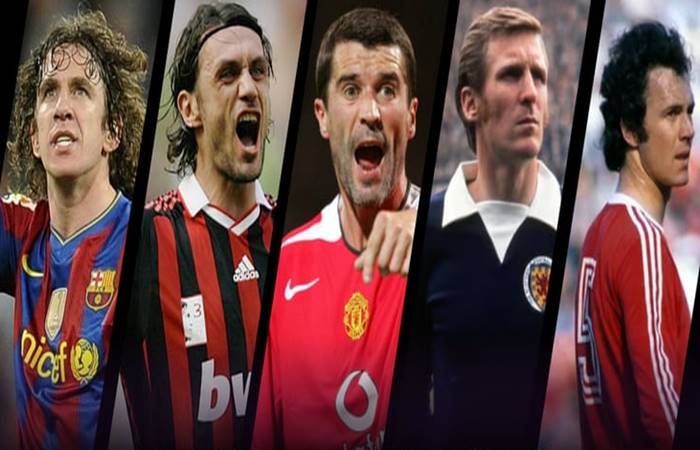
The Armband’s Elite: The 10 Greatest Football Captains in History.
In football, the captain’s armband is more than a piece of fabric; it is a symbol of responsibility, a beacon of authority, and a mantle of legacy. While talent is universal, true leadership is a rare currency. The greatest captains are not always the most technically gifted players on the pitch, but they are invariably the team’s heartbeat—its defiant spirit, its organizing mind, and its unyielding character. They are the ones who stare down adversity, rally the troops when hope is fading, and, in the most critical moments, drag their team across the finish line.
Ranking these titans of leadership is no small feat. It requires looking beyond mere trophy cabinets to understand the intangible influence a captain wields. This list celebrates those extraordinary figures who embodied their clubs, defined eras, and became synonymous with success through a combination of longevity, ferocious will, tactical intelligence, and an unparalleled ability to inspire. Our criteria are strict: we assess their longevity as a leader, their demonstrable leadership skills, the silverware they lifted as captain, and their individual performances when the stakes were highest.
Here are the ten captains who mastered this alchemy and stand above all others.
10. Tony Adams: “Mr. Arsenal” and the Lion of North London
Tony Adams’s career is a tale of two halves, a story of redemption that makes his leadership all the more powerful. In his early years, he was a typical, hard-drinking, no-nonsense English centre-half, leading through brute force and sheer intimidation. However, the arrival of Arsène Wenger in 1996 could have broken a lesser man. Instead, Adams embraced a new philosophy, transforming himself into a refined, professional athlete.
ALSO READ: Top 10 Best Premier League Referees of All Time
This evolution cemented his legend. He became the bridge between the old, rugged Arsenal and the new, invincible Arsenal. His loyalty was absolute—a one-club man who wore his passion on his sleeve. His iconic arms-outstretched celebration against Everton to seal the 1998 Premier League title is the very image of a captain consumed by love for his club. Adams led Arsenal to four league titles across three different decades, a testament to his enduring influence and adaptability, truly earning his moniker, “Mr. Arsenal.”
9. Sergio Ramos: The Clutch Commander of Real Madrid
If a captain is defined by his presence in the biggest moments, few can rival Sergio Ramos. The Spanish defender was the beating heart and rebellious soul of the modern Real Madrid dynasty. Blending world-class defensive prowess with a shocking goal-scoring record for a defender, Ramos was the ultimate big-game player.
His leadership was not always polished, but it was relentlessly effective. He played on the edge, embodying a “win at all costs” mentality that propelled Real Madrid to unprecedented heights. Who can forget his 93rd-minute equalizer in the 2014 UEFA Champions League final against Atlético Madrid, a header that snatched victory from the jaws of defeat and sparked an era of four Champions League titles in five years? Ramos was the galvanizing force, the warrior whose never-say-die attitude became the identity of the most successful Real Madrid side in a generation.
8. Didier Deschamps: The Unassuming Architect
Dismissed by Eric Cantona as a mere “water carrier,” Didier Deschamps is the ultimate testament to the idea that leadership is about intelligence and organization, not just flair. As a player, his role was unglamorous but indispensable: break up play, distribute simply, and organize those around him. He was the on-pitch manager long before he became one off it.
His crowning achievement as a player-captain was leading Marseille to their historic Champions League triumph in 1993, becoming the youngest captain ever to lift the trophy at that time. He then captained France to their 1998 World Cup and Euro 2000 glory, marshalling a star-studded team with quiet authority. Deschamps proved that a captain’s voice doesn’t need to be the loudest to be the most listened to.
7. Carles Puyol: The Heart, Soul, and Hair of Barcelona
In a Barcelona team celebrated for its artistic midfield maestros like Xavi, Iniesta, and Messi, Carles Puyol was the vital counterbalance: the relentless warrior, the uncompromising defender, and the roaring heart of the team. His leadership was built on passion, selflessness, and an unwavering moral compass.
A iconic moment, often replayed, perfectly captures his character: after being shoved by Sergio Ramos, he immediately restrained his own teammate, Gerard Piqué, from retaliating. It was a act of immense discipline that prioritized the team over personal pride. Puyol’s commitment was absolute. He bled for the Blaugrana stripes, leading them through their most successful period with a combination of brutal defensive excellence and pure, unadulterated passion.
6. Franco Baresi: The Maestro of the Milan Defense
Before Paolo Maldini, there was Franco Baresi. For two decades, he was the intellectual and defensive anchor of the great AC Milan sides of the late 80s and early 90s. As the archetypal “libero,” or sweeper, Baresi redefined the position, combining flawless tackling with an extraordinary ability to read the game and initiate attacks from the back.
Captaining a team featuring global superstars like Marco van Basten and Ruud Gullit required a unique authority, and Baresi commanded it through quiet competence and supreme talent. He led Milan to six Serie A titles and three European Cups, building a legacy as one of the most intelligent and technically proficient defenders to ever play the game. His leadership was a masterclass in calm, composed control.
5. Emlyn Hughes: “Crazy Horse” and the Engine of Liverpool’s First Golden Age
Emlyn Hughes, nicknamed “Crazy Horse” for his relentless, all-action style, was the charismatic leader of the first great Liverpool dynasty under Bill Shankly and Bob Paisley. Taking the captaincy in 1973, he immediately ended Liverpool’s wait for a league title, breaking a seven-year drought.
He was the embodiment of the team’s spirit—infectiously enthusiastic, fiercely competitive, and technically superb. Under his captaincy, Liverpool conquered England and then Europe, winning the UEFA Cup in 1973 and back-to-back European Cups in 1977 and 1978. Hughes’s voice and energy were the driving forces that transformed a good Liverpool team into an unforgettable, trophy-hoarding machine.
4. Franz Beckenbauer: “Der Kaiser” Who Ruled the Pitch
Franz Beckenbauer didn’t just lead; he revolutionized. “Der Kaiser” (The Emperor) earned his name through a regal, effortless authority on the pitch. He invented the modern sweeper role, a player who was both his team’s chief defender and its primary playmaker, gliding across the pitch with unparalleled elegance and vision.
His leadership was one of cool, intellectual dominance. He captained Bayern Munich to three consecutive European Cups from 1974-76, establishing them as a European superpower, and then lifted the 1974 World Cup as captain of West Germany. Beckenbauer was the ultimate leader-by-example, a figure so commanding and skilled that his very presence elevated everyone around him.
3. Billy McNeill: “Caesar” and the Lion of Lisbon
Billy McNeill, known as “Caesar,” is the defining figure of Celtic’s history. An uncompromising and dominant centre-half, he was the on-field embodiment of manager Jock Stein’s vision. His legacy is forever sealed in what is known as the “Lisbon Lionhood.” In 1967, he captained Celtic, a team comprised entirely of players born within 30 miles of Glasgow, to the European Cup, becoming the first British club ever to win the trophy.
This historic victory, defeating the mighty Inter Milan, was a monumental upset and a testament to McNeill’s towering leadership. He hoisted nine consecutive Scottish league titles as captain, a staggering run of domestic dominance. McNeill wasn’t just a captain; he was a Celtic icon who carried the hopes of a nation and delivered the ultimate prize.
2. Paolo Maldini: “Il Capitano” and the Embodiment of Class
Paolo Maldini is the definition of loyalty and timeless class. Spending his entire 25-year career at AC Milan, he inherited the captain’s armband from the great Franco Baresi and did not merely fill the role—he expanded its legacy. Maldini’s leadership was not one of fiery speeches, but of profound professionalism, impeccable discipline, and an aura of invincibility.
He made over 900 appearances for Milan, captaining them to five Champions League titles—a feat he achieved as captain and, earlier, as a player. His name became synonymous with the club itself. To be “a Maldini” was to be the ultimate professional. He defended with a poet’s grace and a warrior’s resolve, leading a generation of stars not by shouting, but by setting a standard of excellence that was almost impossible to match.
1. Roy Keane: The Ferocious Soul of Manchester United
Topping this list is the man who was less a captain and more a force of nature: Roy Keane. The Irish midfielder was the relentless, combustible, and utterly indispensable engine of Sir Alex Ferguson’s all-conquering Manchester United. Keane’s leadership was not for the faint of heart; it was a demanding, searing intensity that tolerated nothing less than 100% from every single teammate.
He was the team’s standard-bearer, its conscience, and its competitive fire. His legendary performance in the 1999 Champions League semi-final against Juventus, where he single-handedly dragged United back from a 2-0 deficit to a 3-2 victory while knowing a yellow card would rule him out of the final, is the purest example of captaincy in the modern era. He sacrificed personal glory for the team’s cause. Roy Keane didn’t just lead Manchester United to trophies, including the historic 1999 treble; he infused them with a winning mentality that was as brutal as it was brilliant.
ALSO READ: The Art of Flight: Ranking Football’s Most Iconic Header Goals
Honorable Mentions: Legends Who Defined the Armband
-
Steven Gerrard: The heartbeat of Liverpool for a generation, his “Istanbul Miracle” in 2005 is a one-man exhibition in inspirational captaincy.
-
John Terry: The rock at the center of Chelsea’s rise, a born leader whose defensive mastery and will to win defined the club’s most successful era.
-
Diego Maradona: While his club captaincy was most iconic at Napoli, where he carried a mediocre team to two Serie A titles, his leadership of Argentina to the 1986 World Cup was transcendental.
-
Iker Casillas: “San Iker” was the calm, world-class guardian of Real Madrid and Spain, leading both to unprecedented international success with humility and impeccable skill.
-
Johan Cruyff: Though his official tenure as captain was shorter, his influence was immeasurable. He was the on-pitch conductor and tactical genius who led Ajax to three consecutive European Cups, embodying “Total Football.”
The debate over the greatest captain will rage on, for it is a title measured not just in silver, but in spirit, sacrifice, and the indelible mark left on the beautiful game.